


Does Range Of Motion Matter? How Exercise Depth Changes What You’re Training In Pilates
“Go lower.”
“Full range.”
“Deeper is better.”
“Don’t let the knee bend that far.”
“Keep it small.”
Pilates instructors receive a lot of conflicting advice about exercise range of motion.

Some are taught that full range is always superior. Others are taught that particular joint angles are dangerous.
Then rehabilitation introduces partial ranges. Strength training introduces deep ranges.
And suddenly something as simple as how far a client squats becomes surprisingly confusing.
Range of motion is not a moral hierarchy.
A deeper exercise is not automatically better.
A partial range is not automatically cheating.
Different ranges create different mechanical demands.
The useful question is: Why have you chosen this range for this client and this goal?
What Does Range Of Motion Mean?
Range of motion describes the amount of movement available or used at a joint during a task.
We can discuss a person’s available joint range, such as how far their shoulder can elevate.
We can also discuss the range used during an exercise.
A client may have enough hip and knee mobility to perform a deep squat but deliberately train a partial squat.
Another may want to squat deeper but currently lack the mobility, strength, confidence or tolerance required.
Available range and trained range are related, but they are not identical.
Is Full Range Of Motion Always Better?
No.
Full range can be extremely useful.
Training through larger ranges can expose muscles and joints to forces across more positions and may be valuable for strength, mobility and function.
But there are also legitimate reasons to use partial ranges.
A client may be rehabilitating an injury. A particular range may currently provoke symptoms. You may want to overload a specific portion of a movement. The equipment may constrain range. The client’s sport may require force production within a particular joint angle.
Programming depends on context.
Does Deeper Mean Harder?
Sometimes.
But not always.
As joint angles change, the relationship between gravity or external resistance and the joint changes.
This alters the external moment the muscles need to oppose.
In a squat, for example, moving deeper changes hip, knee and ankle positions.
But difficulty does not increase in a perfectly linear way where every additional centimetre is automatically harder.
The hardest part of an exercise depends on the resistance profile and mechanics.
Why Joint Angle Changes Muscle Demand
Imagine holding a dumbbell with your elbow bent.
As the position of the forearm changes relative to gravity, the external moment around the elbow changes.
The dumbbell weighs exactly the same throughout.
But the muscular demand is not identical at every angle.
This is fundamental biomechanics.
The same principle applies throughout Pilates.
Where the limb sits relative to gravity, springs or external resistance influences how much force muscles need to produce.
What Is A Moment Arm?
A moment arm is the perpendicular distance between a line of force and a joint axis.
You do not need to calculate moment arms mathematically while teaching.
But understanding the concept explains why the same resistance can feel completely different at different points in an exercise.
When the external moment arm becomes larger, the muscles generally need to produce more internal torque to control or move the joint.
This is why exercise position matters so much.
Why A Straight Leg Can Feel Harder Than A Bent Leg
Consider a supine abdominal exercise.
The client can comfortably control a bent-knee leg movement.
You straighten the leg and suddenly the exercise becomes much harder.
The leg did not become heavier.
The lever changed.
Moving the mass further from the relevant joint can increase the external moment.
This is why lever length is such a useful Pilates progression.
But it also means “straighten your legs to make it harder” should be understood mechanically rather than memorised as choreography.
Range Of Motion And Muscle Length
As joints move, muscles change length.
A muscle can produce force across a range of lengths, but its force-producing capacity and mechanical situation vary.
This is one reason exercise range can influence which portion of a movement feels most demanding.
Training muscles at longer lengths has also become an important area of strength and hypertrophy research.
For Pilates instructors, the practical message is not “always chase maximum stretch”.
It is that the range in which you load a muscle matters.
Does A Muscle Need To Stretch To Get Stronger?
No.
Strength adaptation does not require you to feel a stretch.
A muscle can produce force without creating a noticeable stretching sensation.
Likewise, feeling a strong stretch does not prove you are creating a meaningful strength stimulus.
Sensation and mechanics are different.
Is A Deep Squat Better Than A Shallow Squat?
It depends on the goal and the person.
A deeper squat requires greater movement at the hips, knees and ankles.
It also exposes the lower body to load through different joint angles.
For someone who needs deep squat capacity and tolerates it well, training deeper ranges can be valuable.
For another person early in rehabilitation, a shallower range may allow meaningful loading without excessive symptoms.
Neither range is morally superior.
The question is whether the selected range is useful for the intended adaptation.
Are Deep Squats Bad For The Knees?
Deep knee flexion increases certain demands around the knee, but increased load does
not automatically equal damage.
Healthy joints are capable of adapting to load.
For many people, deep squatting can be trained safely.
However, if someone has a current knee presentation that is highly sensitive in deeper flexion, temporarily modifying depth may allow them to continue strengthening.
The long-term goal may then involve progressively restoring deeper-range capacity.
Avoidance and intelligent modification are not the same thing.
Why Partial Squats Can Be Useful
A partial squat may allow someone to train around a currently sensitive range, use greater external resistance, develop confidence, practise a specific portion of a movement or gradually progress towards greater depth.
The problem is not partial range.
The problem is using partial range forever when the client’s goals require capacity beyond it and there is no reason not to progress.
Why Full Range Can Be Useful
Training through larger ranges can expose the body to force across more positions.
For everyday function, this can be valuable.
Think about getting down to the floor, rising from a low chair or moving into a deep lunge.
If we only ever strengthen clients in small ranges, we should not be surprised if larger ranges remain difficult.
Capacity is specific.
Does Range Affect Strength Gains?
Strength adaptations demonstrate some specificity to the ranges and joint angles trained.
That does not mean strength gained in one range has zero transfer elsewhere.
But if someone specifically needs strength in a deeper position, it makes sense for training to eventually expose them to that position.
This has obvious rehabilitation implications.
If stairs hurt in deeper knee flexion, only training the top quarter of a squat may not completely prepare the client for stair descent.
Range Of Motion In Rehabilitation
Rehabilitation often uses range as a dose variable.
Imagine a client with knee pain.
A deep squat currently produces significant symptoms. A shallower squat is comfortable.
Instead of removing squatting completely, you might train the tolerable range.
As capacity improves, depth can gradually increase.
This maintains exposure to the movement pattern while respecting current irritability.
Range becomes part of progressive loading.
Pain At One Range Does Not Mean The Range Is Dangerous
If a particular joint angle hurts, it does not automatically mean that position is damaging tissue.
Pain can be influenced by sensitivity, load, previous injury and many other factors.
Sometimes temporarily reducing range is useful because it reduces symptoms.
But we should be careful about telling clients:
“Your knee should never bend that far.”
“Your spine should never flex.”
“Your shoulder should never go overhead.”
Those messages can create unnecessary fear around normal movement.
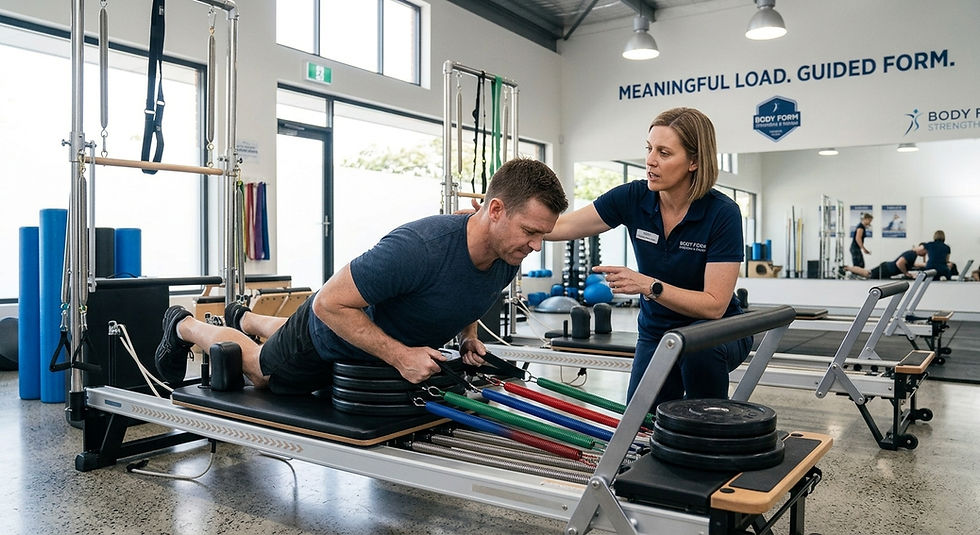
Range Of Motion On The Reformer
The Reformer gives instructors enormous control over exercise range.
Carriage travel can be altered. Footbar position can change starting geometry. Spring resistance can change how the carriage behaves. Props can constrain or increase
movement.
This creates useful programming options.
But instructors should understand why they are limiting or increasing range.
“Small range for beginners” and “big range for advanced clients” is not always accurate.
A small-range exercise can be extremely demanding under heavy load.
A larger range can sometimes be mechanically easier in particular portions.
Example: Reformer Footwork
Consider footwork.
The client begins with the carriage in and extends the legs.
If you alter how deeply the knees and hips flex at the bottom, you change the joint positions from which the client produces force.
A client with knee sensitivity may initially work through a reduced range.
A client training greater lower-limb capacity may progressively use deeper flexion where appropriate.
The spring setting, footbar position and client anatomy all influence the task.
There is no single perfect depth for every person.
Example: Scooter
In Scooter, the hip and knee positions of the standing leg influence the demand.
Ask the client to stand taller and the exercise changes.
Ask them to sit deeper and maintain that position and it changes again.
Neither variation is simply “more correct”.
One may create a greater local endurance or strength demand in a particular position.
The instructor should know why they selected it.
Example: Standing Splits
Range in Standing Splits can be manipulated according to mobility, strength, balance and the desired muscular demand.
More carriage travel is not automatically better.
If increasing range causes the client to lose the intended position entirely or changes the exercise into something else, you may have exceeded the useful range for that task.
Likewise, keeping the carriage movement tiny purely because it creates a burn does not necessarily provide the best progression.
Example: Shoulder Flexion
A client may be comfortable lifting the arms to shoulder height but struggle overhead.
If overhead function matters to them, permanently stopping at 90 degrees may leave the relevant capacity untrained.
Instead, you might progressively expose them to greater range with appropriate resistance.
This is particularly relevant when instructors incorrectly treat overhead movement as inherently risky.
Does More Mobility Mean You Should Use More Range?
Not necessarily.
A hypermobile client may have a large available joint range.
That does not mean every exercise should use the maximum possible range.
Available mobility and useful training range are different.
For some hypermobile clients, strength and control across their available range may be valuable.
For others, loading near end range may need to be introduced gradually.
Again, individualisation matters.
What About Clients Who Are Very Stiff?
A client with less mobility should not automatically be forced into the range demonstrated by the instructor.
Their anatomy, mobility and training history may differ.
You can modify the task while determining whether increasing range is actually a relevant goal.
Not every visible difference needs correcting.
Why Range Changes Leverage
As the body moves, segment positions change relative to resistance.
This changes leverage.
A lateral raise illustrates this beautifully.
With the arm close to the body, the external moment from gravity is relatively small.
As the arm approaches horizontal, the moment becomes much larger.
The dumbbell has not changed.
The muscular demand has.
Pilates exercises behave according to the same mechanical principles.
Why Springs Make Range More Interesting
A spring’s force changes as it changes length.
That means spring-based equipment can have a different resistance profile from a dumbbell under gravity.
As the carriage moves and the spring length changes, spring force changes.
At the same time, body position and joint moment arms may also change.
This is why the hardest part of a Reformer exercise cannot always be predicted simply by saying “the spring gets heavier as you push out”.
The muscle does not experience spring force in isolation.
We need to consider the entire mechanical setup.
What Is A Resistance Profile?
A resistance profile describes how external resistance changes across an exercise’s range of motion.
Different equipment creates different profiles.
Gravity-based free weights have one type. Bands and springs create another. Machines can be designed to alter resistance throughout the movement.
Understanding resistance profiles helps instructors recognise why some exercises challenge particular portions of range more than others.
Why Some Exercises Feel Hardest At The End
If spring tension increases as the spring lengthens, an exercise may become more externally demanding towards one end of carriage travel.
But leverage may simultaneously change.
Depending on the joint and exercise, those effects can reinforce or partially offset each other.
This is why biomechanics requires more than memorising “springs get heavier”.
Should Clients Always Work To End Range?
No.
End range is simply the end of the available movement for that joint or task.
Whether it should be loaded depends on the client, exercise and goal.
Loading end range can be valuable.
It can also be inappropriate in a particular rehabilitation stage.
The question should always be purposeful.
Is Locking Out A Joint Bad?
The word “locking” is often used loosely.
Reaching knee or elbow extension is a normal joint movement.
There is nothing inherently dangerous about straightening a joint.
Some clients, particularly those with greater hyperextension, may need specific cueing depending on the exercise and goal.
But universally telling every client never to straighten their knees or elbows is not evidence-based programming.
Range And Exercise Difficulty Are Not The Same Thing
A bigger range can increase demand.
But so can more resistance, longer leverage, less external support, greater speed, more repetitions and unilateral loading.
You should not use range as the only progression variable.
Sometimes increasing depth is appropriate.
Sometimes increasing resistance while maintaining the same range is more useful.
Range Versus Load: Which Should You Progress First?
There is no universal order.
Suppose a client can squat comfortably to a chair.
You could increase load at that depth.
Or lower the chair and increase range.
Which is better?
It depends on the goal.
If the priority is increasing tolerance to deeper knee flexion, range may take priority.
If the client already has sufficient range but needs greater force production, load may be the better progression.
Programming requires a reason.
How Range Changes The Target Of An Exercise
Pilates instructors often describe exercises by the muscle they “target”.
But changing range can change the relative contribution and demands across muscles and joints.
A squat performed through a small range is not mechanically identical to a deep squat.
A short-range shoulder exercise is not identical to overhead work.
A shallow lunge is not identical to a deep split squat.
This does not mean one exercise isolates a single muscle.
It means the distribution of demand changes.
Range And Tendon Loading
Tendons experience load as muscles transmit force.
Changing joint position and range can alter tendon loading demands.
In rehabilitation, this can be useful.
A Physiotherapist may initially select a range that is better tolerated and then progressively increase range or load.
Pilates instructors working with injured clients should follow appropriate rehabilitation guidance rather than independently assuming that deeper or smaller range is always therapeutic.
Range And Bone Loading
Bone adaptation is influenced by mechanical loading.
Range itself is not the only relevant variable.
The magnitude, direction and rate of force matter too.
For clients with osteoporosis or osteopenia, exercise selection should consider the person’s medical and fracture history alongside appropriate resistance training principles.
Simply moving through a large range does not automatically create an effective bone-strengthening stimulus.
Does Stretching Increase Exercise Range?
Sometimes flexibility limits exercise range.
But not always.
A client may stop a squat because of balance, strength, pain, confidence or anatomy rather than muscle tightness.
If you assume every limited range requires stretching, you may be treating the wrong thing.
Ask what actually limits the task.
Why Anatomy Matters
People are built differently.
Femur length differs. Pelvic structure differs. Hip joint morphology differs. Ankle mobility differs. Shoulder structure differs.
Two clients may therefore use different movement strategies to achieve the same task.
A deep squat does not need to look identical across six bodies.
This is one reason instructors should be cautious about forcing every client into a textbook shape.
Should The Instructor Decide The Client’s Maximum Range?
You guide the exercise, but the range should reflect the client’s capacity and the purpose of the movement.
Instead of simply saying “deeper”, consider:
Can they control the range?
Is it comfortable?
Does the range serve the goal?
Does increasing range meaningfully change the training stimulus?
Is another variable more important?
Good cueing is specific.
Range Of Motion And Fatigue
Range often decreases as fatigue increases.
A client may begin a set with deep, controlled repetitions and gradually shorten the movement.
That tells you something.
Perhaps the muscles are fatiguing. Perhaps the resistance is too high to maintain the intended range.
Whether you stop the set depends on your goal.
If full range is central to the task, decreasing depth may indicate the endpoint.
If partial repetitions are intentionally programmed, the decision may differ.
Again, define the goal before judging the movement.
Partial Repetitions Are Not Automatically Cheating
Partial repetitions can be intentionally programmed.
They may allow greater loading in a specific range or extend a set after full-range repetitions.
Pilates finishers often use pulses, which are essentially repeated work through a smaller range.
That can be useful.
But instructors should understand what changed.
A pulse is not automatically more effective because it burns.
It simply creates a different muscular and mechanical demand.
How To Programme Pulses More Intelligently
If you use pulses, ask why.
Are you extending local muscular endurance?
Increasing time spent in a demanding joint position?
Using a smaller range because the client cannot currently tolerate full range?
Finishing a set after a larger movement pattern?
Those are meaningful reasons.
“Because pulses make everyone burn” is a much weaker programming rationale.
Range In A Pilates Class
Within group classes, clients may require different ranges.
This is not a failure of group programming.
It is good coaching.
One client may squat deeper.
Another may use a smaller range because of current knee symptoms.
Another may have enough mobility but require external support.
The exercise can remain recognisably the same while the range is individualised.
Stop Praising Depth Without Context
Instructors often praise the client who moves furthest.
“Beautiful depth.”
“Amazing range.”
But greater range is not automatically better performance.
If the exercise goal is controlled strength through a selected range, the client who moves further but loses the intended task has not necessarily performed it better.
Praise the quality relevant to the goal.
A Better Range-Of-Motion Framework
Before changing range, ask:
What range does the task require?
What range can the client currently access?
What limits them?
What happens to symptoms as range changes?
How does changing range alter leverage and muscular demand?
Is greater range actually relevant to the client’s goal?
Would increasing resistance be more useful than increasing depth?
How will I progress this over time?
That is more sophisticated than simply categorising small range as beginner and full range as advanced.
Key Teaching Takeaways
Full range is not universally superior.
Partial range is not automatically cheating.
Joint angle changes leverage and muscular demand.
Muscle length changes across range.
Available mobility and useful training range are not the same thing.
Pain in a range does not automatically mean the position is damaging.
Range can be manipulated during rehabilitation.
Deep squats are not inherently bad for knees.
Greater mobility does not mean maximum range should always be used.
Springs create changing resistance across range, but the muscular demand also depends on leverage and exercise geometry.
Pulses are partial-range repetitions and should have a programming purpose.
Fatigue can reduce range and provide useful information about set termination.
Client anatomy influences movement strategy.
And perhaps most importantly:
Range of motion is a programming variable, not a score for how well someone is
exercising.
Learn To See The Mechanics Behind The Movement
Once you understand biomechanics, exercise selection becomes much less arbitrary.
You stop thinking:
“Deep is advanced.”
“Straight legs are harder.”
“More carriage movement is better.”
And start asking:
“What happened to the lever?”
“What happened to the joint angle?”
“Where is the resistance coming from?”
“How did the moment arm change?”
“What range am I trying to strengthen?”
That is the difference between memorising exercise variations and understanding movement.
Our Applied Anatomy & Biomechanics Certification at Body Form Education teaches Pilates instructors to analyse exercises using anatomy, force, leverage and joint
mechanics so you can understand what your programming is actually asking the body to do.
For instructors wanting to turn that knowledge into more purposeful class design, Programming & Cueing Mastery develops the practical application: choosing exercises, layering progressions and cueing clients according to the intended outcome.
The goal is not to make Pilates unnecessarily complicated.
It is the opposite.
When you understand the mechanics, your programming becomes clearer.
You know why you changed the range.
You know what you expected that change to do.
And you can decide whether it actually worked.


Comments