


What Actually Makes An Exercise Strengthening? Understanding Mechanical Tension In Pilates
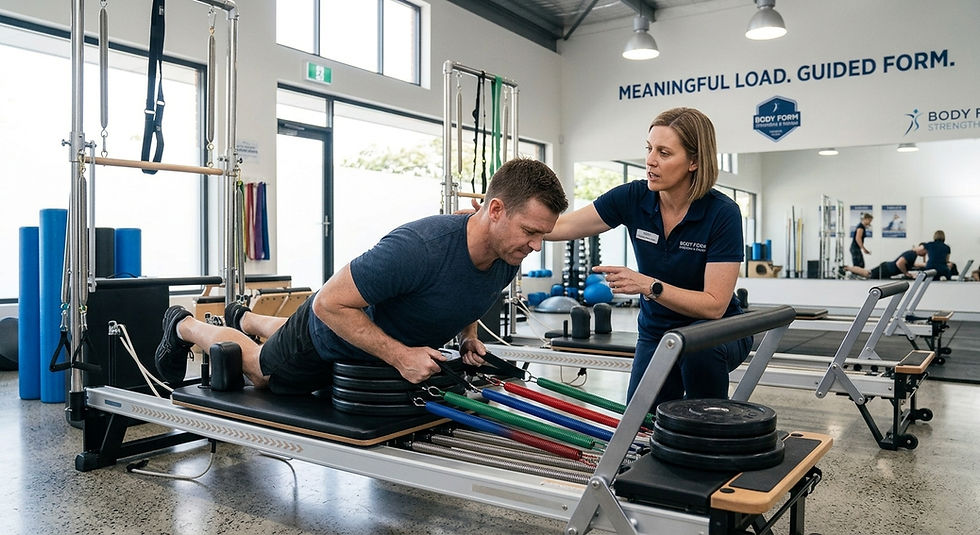
A client is shaking.
Their muscles are burning.
They tell you, “I can really feel that.”
The exercise looks difficult.
So it must be strengthening them, right?
Not necessarily.

This is one of the most important distinctions Pilates instructors need to understand.
An exercise can feel extremely difficult without providing a particularly strong strength stimulus.
An exercise can create an enormous burn without requiring the muscle to produce particularly high force.
An exercise can be complicated, unstable and exhausting while the thing limiting performance is balance rather than muscular force production.
And an exercise can look relatively simple while providing a very meaningful strength stimulus.
If you want to programme Pilates using strength principles rather than simply chasing sensation, you need to understand mechanical tension.
What Is Mechanical Tension?
Mechanical tension refers broadly to the force experienced by muscle fibres when they produce or resist force.
For practical programming, the important point is this: muscle needs to experience sufficient force demand to provide a meaningful stimulus for adaptation.
That force can be created in different ways.
External weights. Spring resistance. Body weight. Gravity. Resistance bands. Machines.
The equipment is not the adaptation.
The muscle responds to the demand created by the task.
Is Mechanical Tension The Same As Heavy Weight?
No.
External load contributes to mechanical tension, but the number written on a dumbbell is not the only thing that determines muscular demand.
Leverage matters. Joint angle matters. Range matters. Resistance direction matters. How close the set is taken to the person’s current capacity matters.
A 3 kg weight can create substantial demand in one exercise and very little in another.
Likewise, the same Reformer spring can create different demands depending on body position and carriage mechanics.
This is why Pilates instructors cannot determine exercise intensity simply by reading the spring colour.
Why Does This Matter In Pilates?
Pilates has historically placed enormous emphasis on control, precision and movement quality.
Those qualities are valuable.
But when the goal is increasing muscular strength, we also need sufficient resistance.
A beautifully controlled exercise that the client could perform for 50 repetitions may not provide the same strength stimulus as a more demanding variation that requires substantially greater force.
That does not make the first exercise useless.
It means the exercises may be training different things.
Does Feeling A Muscle Mean It Is Getting Stronger?
No.
Sensation tells us something about the client’s experience. It does not directly measure force production or future adaptation.
A client may feel intense burning during a low-load exercise because metabolites accumulate locally.
They may feel very little during a heavier compound exercise even though the muscle is producing substantial force.
This is why “Where do you feel it?” can be useful information without becoming the sole measure of exercise quality.
Why Does Pilates Burn So Much?
Long sets, sustained muscular activity and relatively short recovery periods can create a strong local burning sensation.
That burn can make an exercise feel extremely intense.
But perceived burning and mechanical tension are not identical.
If your goal is muscular endurance, longer-duration work may be entirely appropriate.
If your goal is strength, you need to ask whether the muscle is being challenged sufficiently from a force-production perspective.
Does Shaking Mean The Exercise Is Working?
Shaking can occur for several reasons, including fatigue, unfamiliarity and the nervous system attempting to manage the task.
It is not a direct marker of exercise effectiveness.
A client can shake during an unstable balance exercise because maintaining position is difficult.
That does not necessarily mean the target muscle is experiencing a high strength stimulus.
Shaking is information. It is not proof of adaptation.
Strength, Endurance And Control Are Different Goals
Consider three exercises.
A client holds a low-load position for 90 seconds.
A client performs six challenging loaded repetitions.
A client performs a technically complex balance sequence.
All three may be difficult.
But the reason they are difficult differs.
The first may create a substantial muscular endurance demand. The second may create a greater strength demand. The third may be limited primarily by balance and coordination.
Good programming begins by identifying the desired adaptation.
What Is Muscular Strength?
Strength broadly refers to the ability to produce force.
To improve it, the body needs exposure to demands sufficient to stimulate adaptation.
The exact prescription depends on the person and goal.
Beginners can often become stronger across a wide range of loading strategies because almost any meaningful resistance is novel.
As clients become more trained, programming generally needs to become more deliberate.
Does Strength Training Have To Be Low Repetitions?
No.
Muscle and strength adaptations can occur across different repetition ranges.
However, the resistance and proximity to the person’s current capacity still matter.
If someone performs 15 repetitions with a resistance they could actually perform 50 times, the set is unlikely to represent the same stimulus as 15 genuinely challenging repetitions.
This is where your understanding of RPE and reps in reserve becomes useful.
The number of repetitions alone does not tell you the intensity.
How Does Reformer Spring Resistance Create Tension?
Springs create resistance as they lengthen.
But the force experienced by a particular muscle depends on much more than spring tension.
Consider Reformer footwork.
The springs resist carriage movement. The lower limb produces force to move and control the carriage.
Now change the client’s foot position, knee angle, hip angle, carriage position or spring setting.
The muscular demands change.
Spring colour therefore tells you part of the exercise setup. It does not tell you exactly how much mechanical tension an individual muscle experiences.
Why Leverage Matters
A small external load can become substantially more demanding when moved further from a joint.
Consider holding a weight close to your shoulder versus holding the same weight with the arm extended.
The dumbbell has not become heavier.
But the external moment acting around the shoulder has changed.
This is why Pilates can manipulate strength demands without always adding more weight.
Changing lever length can increase or decrease muscular demand.
Why Joint Angle Matters
Muscular force requirements change as joint positions change.
The relationship between the line of resistance and the joint affects the external moment the muscles need to oppose.
This is why an exercise may feel easy in one part of the range and extremely difficult in another.
It is also why simply saying “this exercise trains the glutes” is incomplete.
Which part of the movement? At what hip angle? Against which resistance direction?
Those questions matter.
Is A Heavier Spring Always Better For Strength?
No.
A heavier spring can increase resistance in some exercises. In others, it may provide assistance or alter stability.
You need to analyse what the spring is doing.
“Heavier spring equals harder” is not a universal rule.
Can Bodyweight Exercises Build Strength?
Absolutely.
Body weight is resistance.
A push-up requires the upper body to produce force against a proportion of body weight. A single-leg squat can create substantial lower-limb demand. A plank creates muscular demands even though no dumbbell is present.
The relevant question is whether the exercise provides sufficient challenge for that person.
For a beginner, bodyweight squats may be highly demanding.
For a well-trained client, they may provide relatively little strength stimulus unless the task is manipulated.
Why Unilateral Exercise Can Increase Demand
Moving from bilateral to unilateral work can increase the relative demand placed on one limb.
A two-leg bridge distributes the task across both sides.
A single-leg bridge substantially changes the demand.
But unilateral does not automatically mean better.
Balance, coordination and technique may become limiting factors.
If your goal is maximal lower-body force production, a stable bilateral exercise may sometimes allow greater loading.
Again, exercise selection depends on the goal.
Why Instability Can Reduce Mechanical Tension
When you make an exercise highly unstable, the client may need to reduce external resistance.
Balance becomes the limiting factor.
If your goal was strength, you may have accidentally reduced the amount of force the target muscles can produce.
This does not make unstable training useless.
It means instability and strength are different programming variables.
Does Time Under Tension Build Strength?
Time under tension describes how long muscles are working during an exercise.
It can influence the training stimulus, but more time is not automatically better.
Holding an extremely light resistance for several minutes creates a different demand from producing high force against heavier resistance.
If the goal is strength, extending every set indefinitely is not necessarily the most efficient strategy.
Is Slow Tempo Better For Strength?
Slow tempo can increase control and make a given resistance feel more demanding.
It may be useful for learning, rehabilitation or creating a particular training stimulus.
But deliberately slowing every repetition does not automatically produce greater strength adaptation.
A very slow tempo may reduce the load a client can tolerate.
Sometimes that is appropriate. Sometimes it is not.
Tempo is another variable, not a hierarchy where slower is always superior.
What About Isometric Holds?
Isometric contractions can create substantial mechanical tension if the force demand is high enough.
A wall sit can be very demanding. A heavy isometric calf hold can create meaningful force.
An isometric does not need visible movement to challenge muscle.
But holding any position for a long time does not automatically make it strength training.
Intensity still matters.
What About Eccentric Exercise?
Muscles can produce substantial force during eccentric actions.
Eccentric training can therefore be useful within strength and rehabilitation programmes.
But simply moving slowly during the lowering phase does not guarantee the eccentric demand is high.
Resistance still matters.
The muscle must actually be producing force while lengthening.
Does Muscle Soreness Mean I Created Enough Tension?
No.
Delayed onset muscle soreness can occur after unfamiliar exercise, particularly when eccentric loading or novel ranges are introduced.
But soreness is not required for strength adaptation.
A client does not need to be sore after every session.
Chasing soreness can encourage unnecessary programme changes when consistent progressive training would be more useful.
How Do I Know If A Pilates Exercise Is Actually Challenging Enough?
You need information.
Observe movement quality. Ask about effort. Consider repetitions in reserve. Look at whether resistance has progressed. Consider whether the client could comfortably
perform many more repetitions.
If someone completes 12 repetitions and tells you they could have done another 20, the exercise was probably not particularly challenging from a strength perspective.
If they complete 10 controlled repetitions and feel they had perhaps two or three good repetitions remaining, you have a very different intensity.
Does Every Pilates Exercise Need To Be Strength Training?
Absolutely not.
Pilates can train mobility, coordination, balance, motor skill, muscular endurance, strength, movement confidence and body awareness.
An exercise does not become bad because it is not maximising mechanical tension.
The problem occurs when we claim an exercise is building significant strength while programming it in a way that provides very little strength stimulus.
Know the goal.
Then programme for it.
Why “The Burn” Can Mislead Instructors
Burn is highly persuasive.
Clients feel it. They associate it with effort. Instructors can see the immediate reaction.
But a programme designed entirely around producing burning sensations can become dominated by long low-load sets.
That may develop local muscular endurance.
It may also be enjoyable.
But if the client’s goal is becoming substantially stronger, you need more than sensation.
Why Complexity Can Hide Low Load
Imagine a client standing on one leg on a moving carriage while holding a ball and performing arm movements.
It looks advanced. It requires concentration. It may feel very difficult.
But what limits the exercise?
If the client stops because they lose balance while the working leg could easily produce more force, the exercise is not primarily limited by leg strength.
Compare that with a stable, heavily loaded split squat.
It looks simpler.
But the lower limb may be required to produce substantially more force.
Which is the better strength exercise?
Probably the one where strength is actually the limiting factor.
Mechanical Tension And Hypertrophy
Muscle hypertrophy refers to an increase in muscle size.
Mechanical tension is considered an important stimulus contributing to hypertrophy.
That does not mean every client needs bodybuilding-style training.
But if an instructor claims a Pilates programme will meaningfully build muscle, the programme needs to provide sufficient muscular challenge and progression.
Marketing language does not override physiology.
Why Progressive Overload Still Matters
As the body adapts, the same exercise becomes easier.
If nothing changes indefinitely, the stimulus may eventually become insufficient to continue driving adaptation.
Progressive overload means increasing the training demand over time.
That can involve more resistance, more repetitions where appropriate, greater range, more challenging leverage, more sets or different exercise selection.
But progression should support the goal rather than simply add complexity.
Example: Reformer Footwork
Suppose a client performs footwork every week on the same springs for the same repetitions.
Initially, it may be challenging.
Months later, they complete it comfortably.
If strength is the goal, you need to ask whether the exercise still provides sufficient
demand.
Perhaps resistance increases. Perhaps a unilateral variation becomes appropriate.
Perhaps the client moves to another exercise where greater external load can be applied.
The answer is not automatically “add choreography”.
Example: Side-Lying Hip Work
Side-lying hip exercises often create a strong burn.
They can be useful.
But if the client has performed the same low-resistance variation for years, the burn alone does not prove continued strength progression.
You might manipulate spring resistance, lever length, range or move towards loaded standing work depending on the goal.
Example: Upper-Body Reformer Work
A client performs kneeling arm work with light springs.
They feel their shoulders immediately.
That may be appropriate for endurance, control or rehabilitation.
But if the goal is improving upper-body strength, eventually the resistance may need to increase or another exercise may provide a better loading environment.
The fact that the client “feels their arms” is not enough information.
Programming Strength In Group Pilates
Group programming adds complexity because clients have different capacities.
One spring setting cannot represent the same relative intensity for everyone.
This is why offering meaningful spring options matters.
But the options should correspond to the mechanics of the exercise rather than simply being labelled beginner, intermediate and advanced.
Teach clients to understand effort.
Give them permission to choose a resistance that actually challenges them while maintaining the intended movement.
Stop Making Strong Clients Stay On Beginner Loads
If a client is significantly stronger than the resistance you prescribe, keeping them on a very light setting because it looks cleaner is not necessarily serving their goal.
Movement quality matters.
But so does overload.
The solution is not to sacrifice control.
It is to find an exercise and resistance where the client can produce meaningful force with appropriate control.
A Better Strength Programming Framework
Before calling an exercise strengthening, ask:
What muscle groups am I trying to load?
What external resistance are they working against?
How does the resistance direction interact with the joints?
Is the resistance sufficiently challenging for this person?
What is actually limiting the set: strength, balance, coordination or discomfort?
How will I progress the demand as they adapt?
These questions move programming beyond repertoire.
Key Teaching Takeaways
Mechanical tension relates to muscular force demand, not simply sensation.
Burning and shaking do not directly measure strength stimulus.
External load matters, but leverage, joint angle and resistance direction also matter.
A heavier spring is not universally harder.
Bodyweight can provide meaningful resistance.
Instability may reduce the amount of muscular force a client can produce.
Strength, endurance, balance and coordination are different adaptations.
Slow tempo and long time under tension are tools, not automatic markers of better strength training.
Soreness is not required for progress.
Progressive overload matters if strength is the goal.
And perhaps most importantly: not every Pilates exercise needs to be a strength exercise.
But if you are going to call it strength training, programme it like strength training.
Learn To Programme Strength Beyond The Burn
At Body Form Education, we want instructors to understand what the exercise is doing rather than relying on whether it looks difficult or creates a strong sensation.
Our Strength Pilates Principles Certification teaches instructors how to apply genuine strength-training principles within Pilates programming, including resistance, intensity, progression and exercise selection.
Our Applied Anatomy & Biomechanics Certification takes this further by teaching you to analyse force, leverage, joint position and resistance so you can understand why changing an exercise setup changes the muscular demand.
The goal is not to turn every Pilates class into a gym session.
It is to give instructors enough exercise science to know when they are training mobility, endurance, balance, control or strength.
Because your clients deserve more than an exercise that burns.
They deserve programming that matches the result you told them you were training for.


Comments